Social Pinpoint vs. Senf
Social Pinpoint vs. Senf: which community engagement platform fits a private-sector planning firm
Both platforms let planning teams run map-based community engagement online. The structural difference is who they're built for: Social Pinpoint serves municipalities and government agencies; Senf is built for private-sector planning, design, and engineering consultancies. That single difference produces almost every operational gap you'll feel — user access, pricing model, analysis workflow, and what the platform expects you to do at the end of a project.
This piece is for firms actively evaluating both. The rest of it explains what to look at, and where each platform genuinely wins.
If you're also weighing Social Pinpoint against other government-oriented tools — Go Vocal (formerly CitizenLab), PublicInput, or EngagementHQ — the same question decides the comparison: who is the platform built for. Go Vocal vs. Social Pinpoint is a choice between two platforms designed for the institutional, single-programme buyer; Senf is the alternative built for the consulting firm running a portfolio of projects.
Quick comparison
The differences below are what consulting firms tell us matter most when they're choosing between the two. Pricing for Social Pinpoint isn't publicly disclosed at time of writing; the figures referenced anywhere in this piece are indicative and should be confirmed with the vendor directly during evaluation.
Social Pinpoint | Senf | |
|---|---|---|
Built for | Municipalities, government agencies | Private-sector planning, design, engineering consultancies |
Pricing model | Per-project allotment, annual contract | Project licence (single project) or annual licence (unlimited projects) |
User access | Per-project user assignment; users don't carry across projects | Unlimited team access across all projects |
AI analysis | Export to external tools (Excel, Claude, ChatGPT) | Native AI categorisation and theme extraction |
Map capability | Map-based engagement modules | Map-based engagement plus spatial export to GIS |
Project workflow | Project-by-project setup | Templates, project hub, end-to-end workflow |
Target client | Long-term institutional buyer | Project-based consulting firm |
How Senf and Social Pinpoint differ on user access and team workflow
Social Pinpoint was built for a buyer that runs one engagement programme inside one organisation over many years. The user model reflects that: access is assigned at the project level, and adding a new project means re-assigning the team to it. For a municipality with three planners and one continuous engagement programme, this is a non-issue.
For a consulting firm running fifteen projects across four offices, with project managers rotating on and off engagements as work comes in, it produces friction every week. The pattern that comes up in consulting-firm evaluations: per-project user assignment when a new engagement spins up, templates and project setups that need to be copied across rather than shared natively, and reassignment work that scales with project count rather than team size. It isn't a hard cap or a billing tripwire — it's a workflow tax that compounds when project volume is the thing you're optimising for.
McKenna, a 50-to-100-person Michigan planning firm running engagement across dozens of active municipal projects simultaneously, is the clearest case on record for what this friction looks like at scale. They moved to Senf in part because the per-project setup overhead was a real bottleneck at their volume.
Senf's model assumes the opposite default. Team access is unlimited across all projects under one licence. A new project doesn't require a user assignment step; the team is already in. The model is built for firms whose constant variable is project count, not user count.
AI analysis and the Excel-plus-AI workaround
The standard assumption is that firms using Social Pinpoint do their analysis manually. That's not what we hear on sales calls. The actual baseline is Excel plus an AI tool — Claude or ChatGPT — for categorisation. A planner at Ascent described their workflow:
"Taking data from Social Pinpoint, going through Excel, quantifying them, categorising them, and then using Claude to create key themes."
Two of the last seven prospects we spoke to were running exactly this stack: export from the engagement platform, paste into Excel, prompt an LLM to categorise, paste the categories back in for the report. It works. It also costs hours per project and introduces errors at every paste step. The team at Dialogue put it this way:
"Even though we were using AI for text-based comments — dumping it and asking AI to categorise — having it all in one platform is still very helpful."
That's the gap Senf closes. AI categorisation, sentiment analysis, and theme extraction run on the comment data inside the platform — no export, no prompt engineering, no copy-paste cycle. Senf clients see a 70–90% reduction in analysis time on projects with 1,000-plus open-text responses compared to their previous workflows. Alexandra Albert at YPMO, who has worked across every major platform in this category over twelve years, put it directly: "The AI categorisation is the coolest I've seen in any platform."
For a Platform-Experienced firm, this is usually the section that lands hardest. The pain isn't the absence of AI — it's the workaround that's quietly become the workflow.
Pricing models and what changes for firms with irregular project pipelines
Social Pinpoint doesn't publish pricing publicly, so any specific figure should be treated as indicative and confirmed directly with the vendor. What's consistent across consulting-firm conversations is the model itself: an annual contract with a defined project allotment. Buy the contract, get a fixed number of projects you can run that year.
The model is rational for an institutional buyer with a predictable annual engagement programme. Consulting pipelines aren't predictable. Some quarters bring a wave of small studies, others bring two large comprehensive plans, others bring nothing for two months and then a federal grant cycle that needs three projects spun up at once. A BD principal at Landmark Design described what that produces:
"Sometimes we end up not using all our allotments, other times we need to add more and then it gets really pricey really fast."
The other version of the same friction shows up at renewal. A planner at Ascent flagged it: "A project is associated with a cost that you then have to renew each year — which can be a little confusing." Cost confusion is the polite version. The blunter version is that fixed-fee consulting work doesn't tolerate variable per-project software costs gracefully — every unplanned project allotment is non-billable, and every unused one is a write-off.
Senf offers two licence options: a project licence with unlimited surveys and modules inside it, or an annual licence covering unlimited projects. Either way, the cost is fixed before the engagement starts. For firms whose actual constraint is irregular project flow, that predictability tends to be more valuable than any individual feature comparison would suggest.
When Social Pinpoint is the better fit
There are firms and contexts where Social Pinpoint is the right choice. If the buyer is a municipality or government agency running a single long-term engagement programme — a city's ongoing public-input portal, a transit agency's standing community feedback channel — Social Pinpoint is built for that. The user model fits, the pricing makes sense, and the procurement context favours an established government-sector vendor.
It's also the better choice for organisations whose internal procurement strongly prefers established government-sector vendors, where switching to a younger company is harder than tolerating the workflow tax. That's a real constraint, and the comparison should acknowledge it.
If you're a consulting firm whose primary contract is a single multi-year municipal engagement programme — not a portfolio of projects — Social Pinpoint may work fine. The friction described in this piece comes from project volume; without volume, the friction doesn't show up.
When Senf is the better fit
Senf is built for the consulting-firm operating model. Where the work is project-based, the team is constantly cycling across engagements, and the pipeline is irregular, the platform's structural choices line up with the firm's actual constraints.
McKenna is the clearest case on record — the Michigan planning firm running engagement across dozens of active municipal projects simultaneously, who switched from Social Pinpoint and ran 2,400-plus comments through Senf's categoriser in 90 minutes. The displacement was about volume; the analysis time saving was the cumulative effect.
Design Collective uses Senf differently — embedded in the proposal process. Brian Reetz, Principal at Design Collective:
"Including Senf in our proposals has become a real competitive advantage for Design Collective. It signals innovation to clients — and it wins projects."
For a Mid-Atlantic firm competing in proposal-heavy markets, the platform isn't just an analysis tool — it's part of the differentiation story when bidding.
Bohler Engineering operates Senf at a different scale entirely: a 500-to-1,000-person land development firm with 43 US offices, using the platform to produce structured community-support documentation for planning commission reviews. The use case is downstream of comprehensive planning — entitlement support — and the platform fits because the firm's pain is documentation rigor at volume.
The pattern across all three: firms running consulting workflows where project count, irregular pipelines, and downstream client deliverables are the operating reality. That's the audience the platform was built for.
Frequently asked
How much does Social Pinpoint cost for consulting firms?
Social Pinpoint doesn't publish pricing publicly. The model is an annual contract with a defined project allotment; the specific figure depends on project volume, contract terms, and current vendor pricing. Request a quote directly when evaluating.
Can we keep using Social Pinpoint for existing projects and try Senf on new ones?
Yes. The cleanest evaluation approach is to run a single new project on Senf in parallel — typically a project that's just kicking off — and compare the workflow side by side without disrupting in-flight engagements. Several firms have run this kind of parallel evaluation for a quarter before deciding whether to consolidate.
How long does the switch from Social Pinpoint take?
For firms running multiple active projects, the practical migration is gradual: new projects start on Senf, existing projects finish on Social Pinpoint, and the contract is non-renewed at the next cycle. Onboarding for a new firm typically takes a few days for the engagement lead to set up the first project; templates accelerate everything after the first one.
Does Senf integrate with ArcGIS?
Yes. Spatial data collected in Senf — point comments, route drawings, polygon feedback — exports to standard GIS formats and lands cleanly in ArcGIS workflows. This matters because consulting firms running corridor studies or comp plans almost always need the spatial output to feed downstream GIS analysis.
Is Senf used by municipalities?
Rarely. The platform isn't built for municipal procurement and doesn't position itself for that buyer. If your primary client is a city or county buying the platform directly, Social Pinpoint or one of its government-focused peers is a better fit.
What should we ask Social Pinpoint about platform stability and any recent migrations?
This is the right question to put to the vendor directly during evaluation rather than relying on industry chatter. Ask: what platform changes have customers experienced in the last 18 months, what was the migration support model, and what's the roadmap for the next 12 months. The answers — and how readily the answers come — will tell you what you need to know.
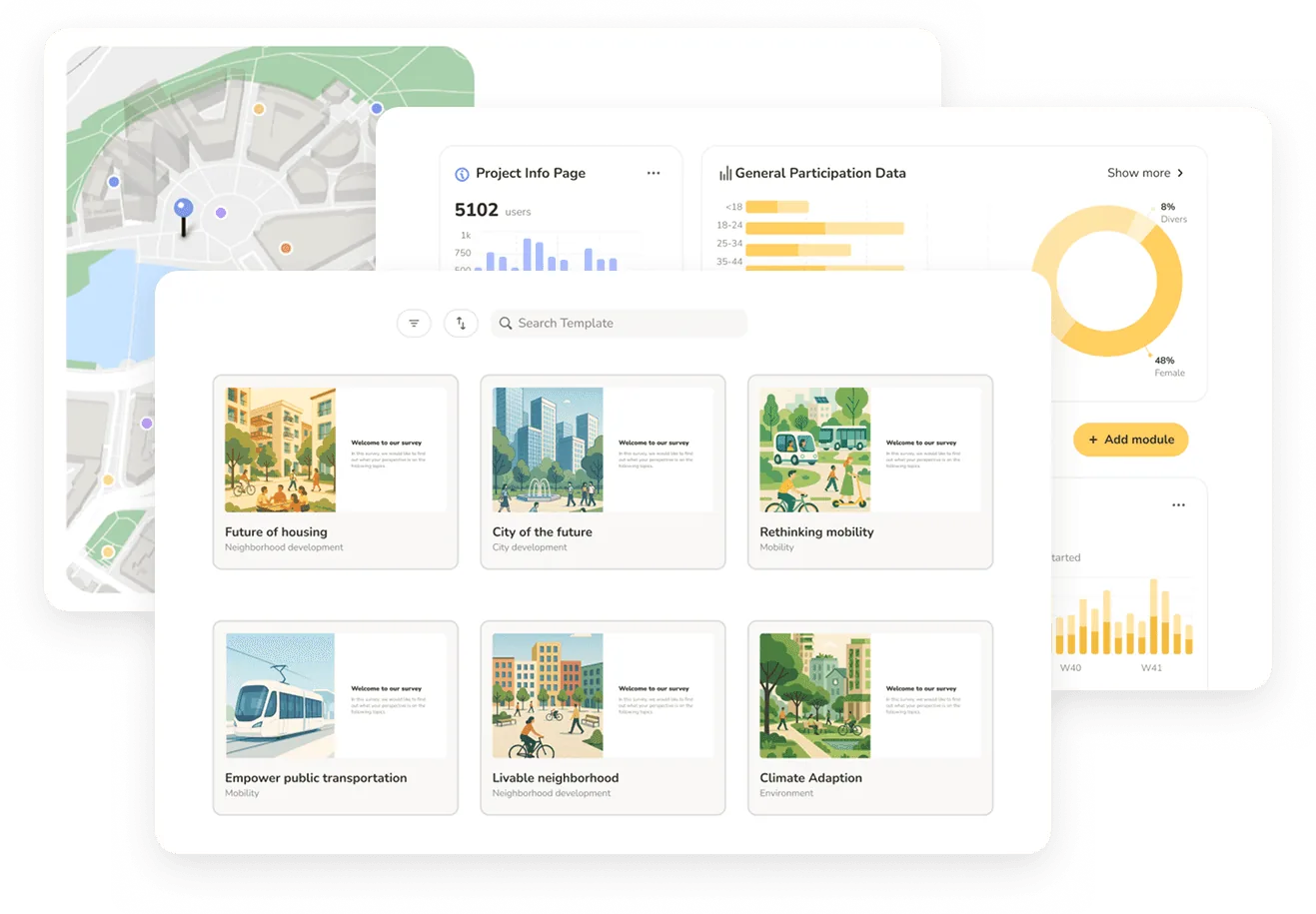
See Senf in action
• Walk through a project scenario relevant to you
• See setup, engagement, and analysis end to end
• Discuss pricing based on your project volume
See Senf in action
• Walk through a project scenario relevant to you
• See setup, engagement, and analysis end to end
• Discuss pricing based on your project volume
See Senf in action
• Walk through a project scenario relevant to you
• See setup, engagement, and analysis end to end
• Discuss pricing based on your project volume